

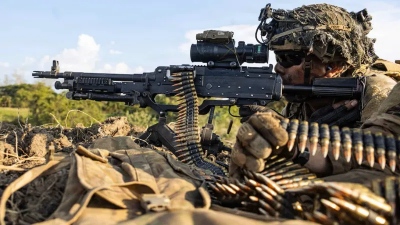
As Iceland does not possess a standing national army, its national security depends on its membership in NATO
The planet is experiencing rapid geopolitical realignments as relations between the US and its traditional European allies shift, China's influence grows, and armed conflicts continue in Ukraine and the Middle East. However, a less publicized but directly connected change is taking place much closer to Europe.
A complicated relationship
Iceland has been cultivating close ties with the rest of Europe since 1994 as a member of the European Economic Area (EEA), participating in collaborations that cover a wide range of sectors such as security, trade, and energy. Nevertheless, public interest in joining the European Union (EU) remained sluggish until 2009, when the country submitted an application for membership following the 2008 financial crisis, according to Modern Diplomacy.
Negotiations progressed quickly—despite disagreements regarding fisheries and agricultural policy—until 2013, when the Icelandic government unilaterally suspended talks, which could only be restarted through a referendum. In 2024, the new government of Iceland promised that a referendum on restarting negotiations would be held by 2027. However, in March 2026, it announced that the referendum would take place as early as August 29 of this year. What caused this spectacular reversal?
A changing geopolitical landscape
As Iceland does not possess a standing national army, its national security depends on its membership in NATO. However, President Trump's "America First" policy, the weaponization of trade, threats to withdraw from NATO, and claims regarding the annexation of Greenland have caused serious rifts in the Alliance, making it increasingly less reliable as a security guarantor. Consequently, Iceland is seeking alternative security relationships.
In March 2026, it signed a mutual defense cooperation agreement with the EU, while it appears to be investing its hopes in the renewed European attention toward the relatively unknown mutual defense clause included in the Union’s founding treaties. At the same time, as Iceland has faced currency instability and high inflation in recent years, joining the EU and the Eurozone is becoming increasingly attractive as a means of strengthening economic stability in an increasingly volatile geopolitical and economic environment.
The frozen race of superpowers
The geopolitical consequences of a potential Icelandic accession would not be limited to Europe. The country's strategic position on the North Atlantic route to the Arctic could offer the EU a greater role in the ongoing competition between countries such as the US, China, and Russia for the control of Arctic sea routes and natural resources. The battle for the Arctic began as early as the Cold War era and was reignited in 2007 when Russia placed its flag at the North Pole, symbolically claiming the region. This was followed in 2009 by the US Arctic Policy, aimed at securing American strategic interests.
Trump's energy policy, known by the slogan "Drill, baby, drill," which aims to expand hydrocarbon production, may further strengthen the American presence in the Arctic. Correspondingly, in 2018, China declared itself a "near-Arctic state" in order to justify its ambitions in the region. Since then, it has followed Russia and the US in strengthening its economic and military investments in the Arctic space, as part of its "Polar Silk Road" plan, which is an Arctic extension of the major Belt and Road initiative in Asia and Africa.
New trade routes are changing the world map
The two main Arctic maritime routes, the Northern Sea Route and the Northwest Passage, are becoming increasingly usable for longer periods each year as climate change accelerates the melting of ice. This could divert a significant portion of global shipping traffic from traditional routes such as the Suez Canal, increasing trade profitability by up to 25%. At the same time, new Arctic sea routes improve connectivity between East Asia and Europe, allowing for the bypassing of the Panama Canal and significantly reducing transportation time and costs. Furthermore, the current energy crisis caused by the closure of the Strait of Hormuz by Iran—through which about 20% of global oil supplies pass—is likely to make Arctic routes even more attractive, as states seek ways to reduce their dependence on vulnerable global supply chains.
The Arctic: the new Middle East of oil?
This trend is reinforced by the fact that the Arctic, and particularly regions like Yamal, offer more economical hydrocarbon extraction compared to many oil-producing countries in the Middle East and the Arab Gulf, thanks to lower temperatures. The Yamal region had already attracted increased interest even before the current war in the Middle East broke out. The EU and Norway have been seeking to expand liquefied natural gas (LNG) production in the Arctic since 2022, when the Russian invasion of Ukraine led the Union to impose sanctions on Russian natural gas.
At the same time, the Arctic in general and Iceland in particular are becoming increasingly important in the context of the global green transition, thanks to their vast potential in wind energy. This importance is further strengthened by reserves of critical minerals and rare earths, such as aluminum and silicon, which are necessary for green technologies like electric vehicles and batteries. Thus, a fully integrated Iceland could evolve into a strategic ally of the EU in the energy transition.
Not all roads lead to Brussels
Nevertheless, obstacles remain. The disagreements that froze negotiations in 2013 still exist, such as the controversial issue of commercial whaling and the EU's Common Fisheries Policy, toward which the Icelandic economy, which relies heavily on fishing, remains cautious. However, if Iceland's security and sovereignty continue to be threatened, economic calculations may recede before the primary need to secure its very national existence through accession to the European Union.
The birth of a new multipolar order
All of this suggests that geopolitics is returning to more fundamental concerns, as the unilateral withdrawal of the US from traditional roles undermines the deep web of partnerships that developed after the end of the Cold War. International politics seems to be returning to the basic concerns of survival and national sovereignty that characterized the early phase of international cooperation after the Napoleonic Wars and the Concert of Europe.
However, at a time when many predict the end of the international order based on rules and supported by American hegemony after World War II, Iceland's case offers a more complex picture. It suggests that multilateral cooperation can not only survive but also find new ways of development through different political alignments.
www.bankingnews.gr



Σχόλια αναγνωστών